Biweekly AI Pulse – Edition #1 January 2026 | Will People Ever Accept AI-Generated Content?
January 12, 2026
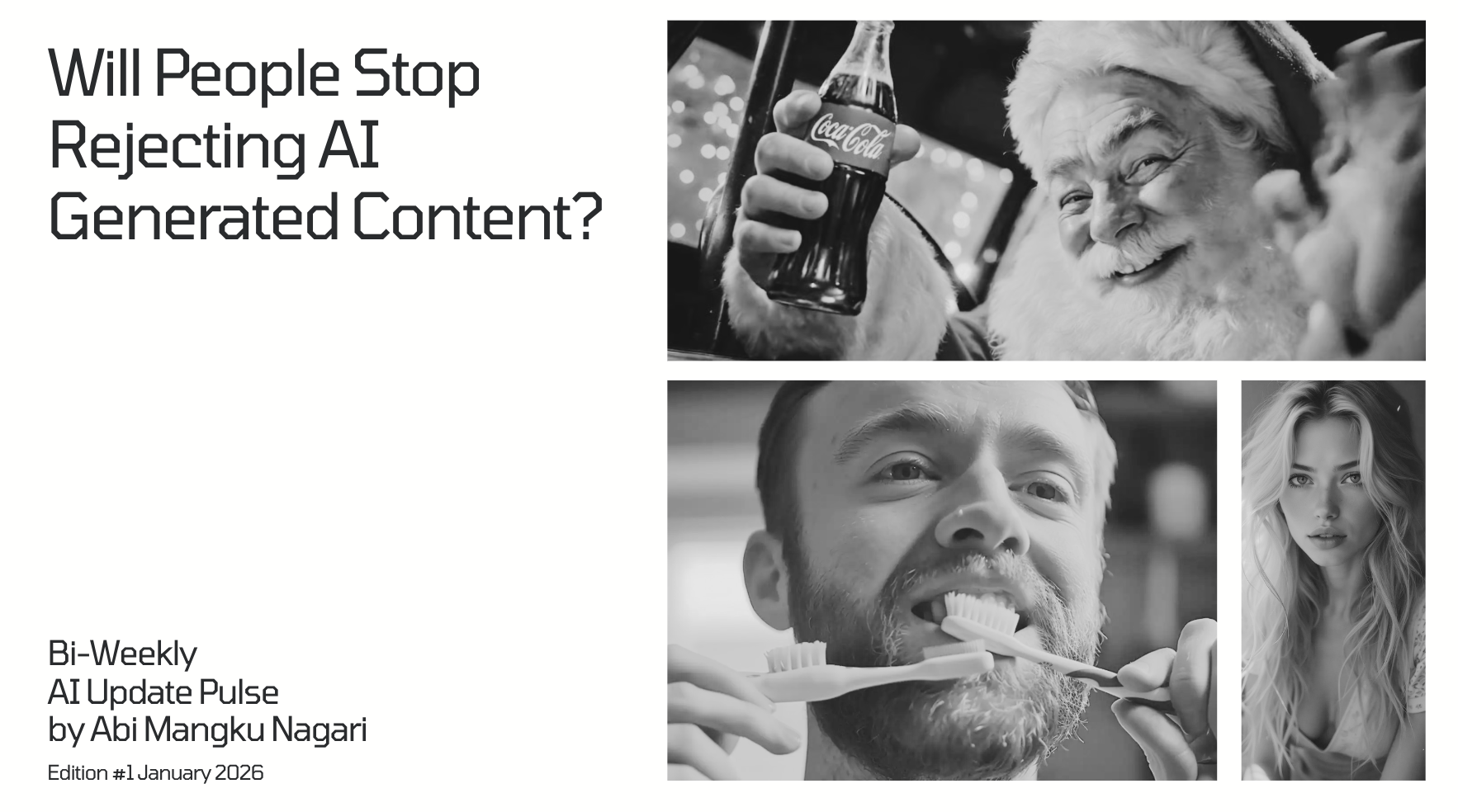
This edition of Biweekly AI Pulse explores a question that keeps resurfacing as AI content becomes more human-like:
Will people ever truly accept AI-generated content?
The short answer is not yes or no. It’s selective acceptance.
Research shows that people don’t reject AI because it looks bad. In many cases, they can’t even tell the difference anymore. The rejection happens when people discover the source. That discovery triggers what researchers call the authenticity valley—a sharp emotional re-evaluation when meaningful content turns out to be non-human.
This Pulse breaks down three psychological mechanisms behind that rejection:
- Why humans associate emotional value with visible effort
- Why AI feels especially “wrong” in emotional or symbolic contexts like holidays and brand storytelling
- Why disclosure creates a paradox: hiding AI risks backlash, but transparency can reduce trust in certain situations
It also looks at real data from marketing and creative work. Pure AI content consistently underperforms. Human-only content performs well but doesn’t scale. Hybrid approaches—AI with human judgment—outperform both, delivering higher engagement, higher conversion, and better trust.
The key insight is context.
AI works best in functional communication, where speed and accuracy matter more than emotional meaning. In emotional communication, human effort still carries psychological weight. That isn’t a flaw in people. It’s a feature.
This Pulse argues that AI is not meant to replace final output. It’s meant to improve the process—structuring thinking, generating options, accelerating work—while humans remain responsible for judgment, meaning, and emotional responsibility.
AI is leverage.
Not replacement.
This is not academic research and not a claim of absolute truth. It’s a thinking document—built from research, observation, and hands-on experience—shared openly as part of an ongoing learning journey.
No previous issue
No next issue